If you have been following digital marketing over the last few years, you have probably noticed one big change. Artificial intelligence is now part of almost every marketing tool, and it is changing the way businesses create content, find ideas, and improve their websites.
Because of this, many people have started asking the same question. Is traditional SEO still useful, or has AI completely changed the rules?
The simple answer is no. Traditional SEO has not disappeared. Instead, it has evolved. AI has made many SEO tasks faster and easier, but it has not replaced the need for useful content, real expertise, or a website that people trust.
Search engines have also become much smarter. They no longer focus only on matching keywords. Today, they try to understand what people are really looking for and whether a page provides the best answer.
In this guide, we will look at the real differences between AI SEO and traditional SEO, explain what has changed in 2026, and show why the best results come from using both together.
What is Traditional SEO?
Traditional SEO is the process of improving a website so that it appears higher in search results. Before AI tools became popular, almost every task was done manually. Marketers researched keywords, planned content, fixed technical issues, improved page speed, and built backlinks by spending hours on research and analysis.
The goal was simple. Create pages that answered people’s questions while making the website easy for search engines to understand.
Although many tools were available, success depended heavily on human experience. Marketers had to study competitors, understand search trends, and regularly update their websites whenever search engines introduced new ranking changes.
For many years, this approach worked well because search engines mainly focused on content quality, website performance, and relevance.
The Core Elements of Traditional SEO
Even today, the foundation of traditional SEO remains valuable. Some of its most important parts include:
Creating Helpful Content
Content has always been one of the biggest ranking factors. Businesses that publish useful and trustworthy information are more likely to earn the attention of both users and search engines.
Technical Website Health
A website should load quickly, work properly on mobile devices, and make it easy for visitors to find information. Technical improvements may not always be visible, but they have a major impact on user experience.
Building Authority
Search engines trust websites that consistently provide accurate information and earn mentions from other trusted websites. This authority cannot be built overnight and usually requires consistent effort over time.
Understanding User Needs
Successful SEO has never been about adding keywords everywhere. It has always been about understanding why someone is searching and giving them the answer they need.
These principles still matter today, even though AI has changed how marketers work.
What is AI SEO?
AI SEO refers to using artificial intelligence to improve different SEO tasks. Instead of doing everything manually, marketers now use AI powered tools to speed up research, organize ideas, suggest content improvements, and analyze large amounts of data.
For example, instead of spending several hours finding related topics, AI can group similar search queries into useful content clusters within minutes.
AI can also help with tasks such as:
- Generating article outlines
- Finding missing topics
- Improving readability
- Suggesting headings
- Creating content briefs
- Reviewing existing pages
- Identifying technical issues
This allows marketing teams to spend less time on repetitive work and more time creating better strategies.
However, AI should be seen as an assistant rather than a replacement. It can process information quickly, but it cannot replace human experience, creativity, or industry knowledge.
Why AI Has Become So Popular
The biggest reason is speed. Many businesses publish content regularly, and manually researching every topic takes a lot of time. AI helps reduce that workload by providing quick suggestions and organizing information efficiently.
Imagine you own an online furniture store. Earlier, you might spend an entire afternoon researching different topics related to dining tables, materials, styles, and buying guides.
Today, AI tools can organize these topics into logical groups within minutes. Instead of starting from a blank page, your team can immediately begin improving the content with real examples, expert advice, and helpful information.
This makes the entire content creation process faster without removing the need for human review.
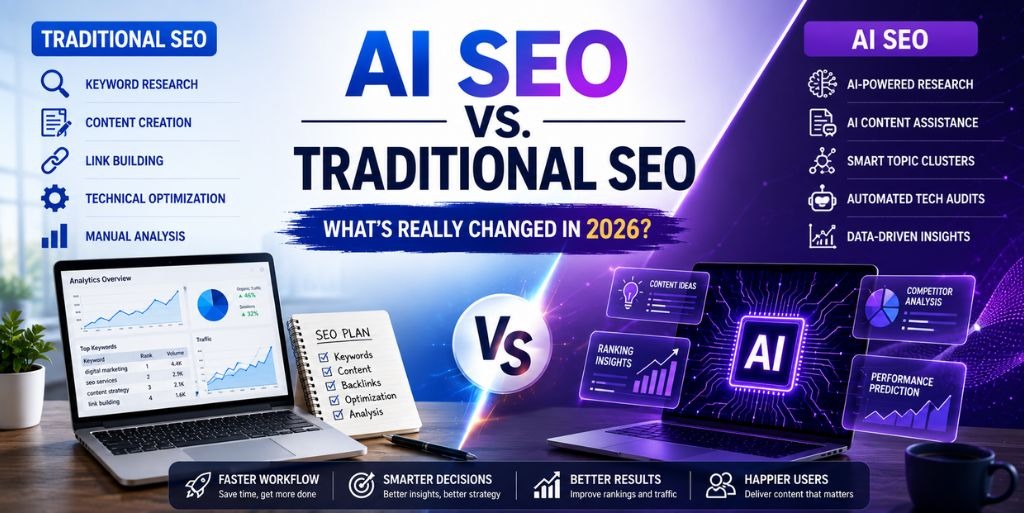
AI SEO vs. Traditional SEO
Although both approaches have the same goal of improving online visibility, the way they achieve it is quite different.
| Traditional SEO | AI SEO | Why It Matters |
|---|---|---|
| Manual research | AI assisted research | Saves valuable time |
| Content planned manually | AI suggests outlines | Faster planning |
| Manual competitor analysis | AI compares data quickly | Better insights |
| Manual technical checks | Automated website audits | Faster issue detection |
| Human content writing | AI assisted drafting | Higher productivity |
| Manual reporting | AI generated reports | Easier performance tracking |
The biggest difference is not quality. It is efficiency.
AI helps complete repetitive tasks much faster, but human knowledge is still needed to make content accurate, useful, and trustworthy.
Does AI Replace Human Writers?
This is one of the biggest myths in digital marketing today.
AI can create text quickly, but speed does not always mean quality.
- It cannot share personal experience.
- It cannot interview customers.
- It cannot test products.
- It cannot understand every industry in depth.
Most importantly, it cannot think like someone who has solved real problems for real clients.
Readers want advice they can trust. That trust comes from real knowledge, practical examples, and honest opinions. These are things that AI alone cannot provide.
The best content in 2026 is created when AI handles repetitive tasks while people add expertise, creativity, and real world insights.
Why the Debate Is Growing
The discussion around AI SEO versus traditional SEO has become more popular because search itself has changed.
People are asking longer questions.
- Voice search continues to grow.
- AI generated answers appear directly in search results.
- Users expect faster and more accurate information.
As a result, businesses need more than just good writing. They need content that genuinely helps readers understand a topic and solve a problem.
That is why the focus is no longer on choosing between AI and traditional SEO. The real goal is learning how to use both in the smartest way.
What Has Really Changed in 2026?
AI has introduced many new ways to work, but the biggest changes are not about replacing SEO. They are about changing what search engines expect from websites.
Here are the biggest shifts businesses should understand.
Search Engines Understand Intent Better
Years ago, adding the right keywords to a page was often enough to rank well. Today, search engines are much better at understanding what people actually want.
For example, someone searching for “best running shoes for beginners” is looking for advice, comparisons, and buying tips. A page that simply repeats the keyword without answering those questions is unlikely to perform well.
The focus has moved from matching words to solving problems.
Helpful Content Wins Every Time
Publishing more content does not automatically bring more traffic. Search engines now reward pages that answer questions clearly, provide useful information, and leave readers satisfied.
Instead of creating ten short articles about similar topics, it is often better to publish one detailed guide that covers everything a reader wants to know.
Experience Matters More Than Ever
People trust content written by someone who understands the topic. Adding practical examples, sharing lessons learned, or explaining real situations makes an article more valuable than one that simply repeats information found elsewhere.
This is one reason businesses should always review AI generated drafts before publishing them.
Building a Brand Is Becoming More Important
As AI makes content creation easier, many websites begin to sound similar. Businesses that build a trusted brand stand out because people recognize their name, return to their website, and recommend their content to others. Trust is becoming just as valuable as rankings.
What Has Not Changed?
While technology continues to improve, many SEO basics remain exactly the same.
- Good websites still need fast loading pages.
- Visitors still expect simple navigation.
- Clear headings still make content easier to read.
- Internal links still help users discover related information.
- Fresh content still performs better than outdated pages.
- Most importantly, people still want honest answers from reliable sources.
These fundamentals continue to make the biggest difference over the long term.
Benefits of AI SEO
When used correctly, AI offers several advantages.
- It saves time during research and planning.
- It helps discover content opportunities that might otherwise be missed.
- It can organize large amounts of information into useful topic groups.
- It makes updating older articles much faster.
- It also allows teams to spend more time improving content quality instead of repeating the same manual tasks.
For growing businesses with limited resources, this can make a significant difference.
Limitations of AI SEO
Although AI is impressive, it is far from perfect.
- Sometimes it produces incorrect information.
- It may create content that feels repetitive.
- It cannot replace personal experience or professional judgment.
- It also struggles to understand unique business goals without clear guidance.
- That is why every AI generated article should be carefully reviewed before it goes live.
The best results always come from combining automation with human expertise.
The Best Strategy for Businesses in 2026
Instead of choosing one approach over the other, successful businesses combine both. AI can handle research, topic ideas, outlines, and first drafts.
People can then improve the content by adding real examples, checking facts, improving readability, and making sure every section genuinely helps the reader.
A successful Search engine optimization (SEO) strategy today is not about using the latest tool. It is about creating useful content that answers real questions while making your website easy to understand for both users and search engines.
This balanced approach helps businesses grow steadily instead of chasing short term trends.
Common Mistakes to Avoid
Many businesses rush to publish AI generated content without checking its quality.
- This often leads to articles that feel generic and provide little value.
- Some websites also focus too much on publishing large amounts of content instead of improving existing pages.
- Others ignore technical website issues or forget to update old articles that no longer reflect current information.
- Another common mistake is copying competitors instead of adding original ideas.
The websites that perform best are usually the ones that provide fresh insights, practical advice, and content that readers cannot easily find somewhere else.
Looking Ahead
Search is continuing to evolve, and businesses need to adapt to changing user expectations. Some of the biggest trends include:
- AI assistants will become more common.
- Voice and visual search will continue growing.
- Users will expect answers that are faster, clearer, and more personalized.
Businesses that focus on helping people instead of trying to trick search engines will continue to succeed regardless of future algorithm updates.
If you want to understand how trust, experience, and content quality influence modern search results, this guide on EEAT and Google SGE explains these concepts in more detail and is a helpful next read.
Working with a professional content marketing service can also help businesses create consistent, valuable content that supports long term growth instead of relying only on automation.
Final Thoughts
AI has changed how marketers research topics, organize information, and improve content, but it has not changed the main goal of SEO. People still want useful answers, trustworthy information, and a great experience when they visit a website.
Businesses that combine AI with human expertise will be in a much stronger position than those that depend on only one approach. The future belongs to brands that create content with real value, not just more content.
If you are planning to improve your website, attract more qualified visitors, and stay ahead of changing search trends, Cubic Digital is here to help. Our team focuses on practical strategies, high quality content, and long term growth so your business can build lasting online visibility with confidence.