Getting leads is not always difficult. Getting the right leads is. For businesses that sell expensive products or services, hundreds of random inquiries don’t mean much. What matters is finding people with a real need, enough interest, and the ability to buy.
This is where an AI-driven digital marketing funnel can make a real difference. AI can help businesses understand their audience, attract the right visitors, identify serious prospects, and follow up with them at the right time.
The good news is that you do not need to make your marketing complicated. A simple funnel, the right content, good data, and smart automation can help you turn more visitors into high ticket leads.
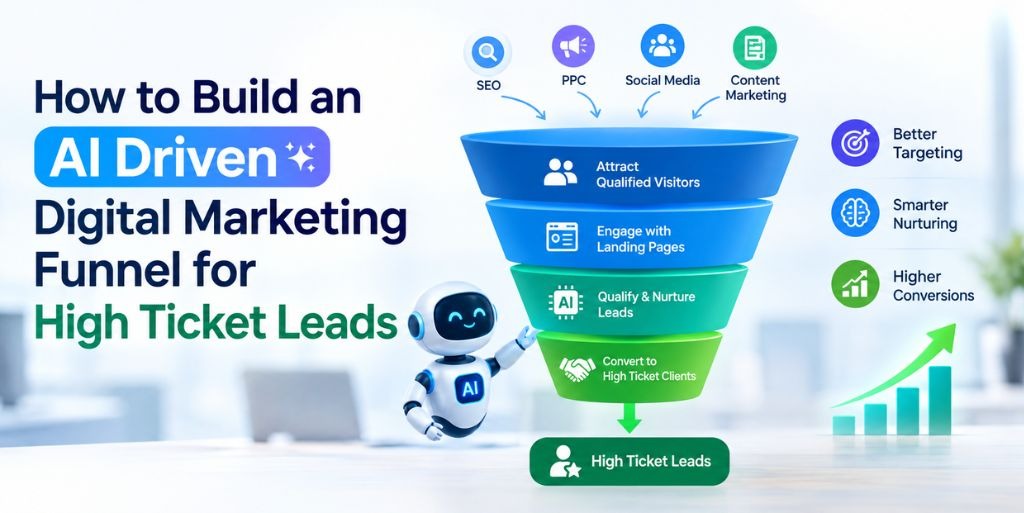
What is an AI-Driven Digital Marketing Funnel?
A digital marketing funnel is the journey a person takes from first discovering your business to becoming a customer. AI makes this process smarter by helping you understand what people are looking for and how they behave.
For example, AI can help identify which visitors are more likely to become customers. It can also help personalize content, improve follow-ups, organize leads, and find areas where people are leaving the funnel. Think of it as having a better view of your potential customers at every stage.
Instead of sending the same message to everyone, you can provide more useful information based on where each person is in the buying journey.
Why High Ticket Leads Need a Different Approach
Someone buying a low cost product may make a decision within a few minutes. A person considering a high-value service may take weeks or even months.
They may compare different businesses, read reviews, visit your website several times, speak with your team, and ask many questions before making a decision.
That means high-ticket lead generation needs patience. Your goal should not be to push people into buying immediately. Your goal should be to build trust and give them enough useful information to feel confident about taking the next step.
This is where a well-planned sales funnel becomes valuable.
Step 1: Understand Your Ideal Customer
Before using AI or running any campaign, understand who you want to attract.
Ask simple questions.
- Who needs your service?
- What problem are they trying to solve?
- What makes them choose one company over another?
- What questions do they ask before buying?
- What could stop them from making a decision?
The answers help you create a clear customer profile.
You can then use customer data and search behavior to find patterns. For example, you may discover that people who search for detailed service information are more likely to contact your business than people who only search for general information. This information can help you create better content and target the right audience.
Step 2: Attract the Right People
A good funnel starts with the right traffic. SEO, PPC, social media, and content marketing can all bring people to your website. The important part is making sure your campaigns are aimed at people who actually need what you offer.
SEO can help you reach people who are already searching for a solution. PPC can help you reach people with stronger buying intent. Social media can help create awareness and build trust.
AI can support these activities by helping analyze search terms, audience behavior, campaign data, and content opportunities. If you want to understand how AI is changing SEO, you can also read our guide on AI SEO vs. Traditional SEO.
But the goal should always be quality traffic, not simply more traffic. A thousand visitors who are not interested in your service are less valuable than fifty visitors who have a real need.
Step 3: Create Landing Pages That Answer Questions
Once people reach your website, give them a clear reason to stay. A high-ticket landing page should quickly explain what you offer, who it is for, what problem you solve, and what the visitor should do next. Avoid filling the page with complicated words or too much information.
Use clear headings, simple explanations, helpful proof, and a strong call to action. AI can help you study which parts of a landing page are getting attention and which parts may need improvement. However, the final content should still sound natural and match your brand.
People want to feel that they are talking to a real business that understands their problem.
Step 4: Use AI to Qualify Leads
Not every person who fills out a form is ready to speak with your sales team. Some may only be looking for information. Others may have a genuine need and be ready to discuss the project.
AI lead scoring can help separate these different types of prospects. You can look at factors such as the pages someone visited, the information they requested, their company details, their actions on your website, and their level of interest.
A lead who reads several service pages, downloads useful information, and requests a consultation may be more valuable than someone who only visits your homepage.
This does not mean AI should make every decision. Your sales team should still review important leads and use their experience.
Step 5: Nurture Leads That Are Not Ready
One of the biggest mistakes businesses make is giving up on a lead too quickly. Someone may be interested in your service but not ready to buy today. This is common with high-ticket services.
Email marketing automation can help you stay connected without sending the same message again and again. You can send useful guides, answers to common questions, case studies, industry information, and other helpful content. The purpose is simple. Stay useful and stay remembered.
When the person is finally ready to make a decision, your business is more likely to be considered.
Step 6: Personalize the Customer Journey
People respond better when the information they see matches their needs. AI personalization can help businesses deliver more relevant content based on customer behavior.
For example, someone interested in PPC may see more information about paid advertising, while someone researching SEO may receive content related to organic search and website visibility.
The same idea can be used in email campaigns, landing pages, advertisements, and follow ups. Personalization does not have to feel complicated. Even small changes can make the customer experience more relevant.
Step 7: Combine SEO and PPC
SEO and PPC can work very well together in a high-ticket marketing funnel. A strong SEO strategy can bring steady organic traffic from people searching for solutions. PPC services can help you reach people who are actively searching for specific products or services.
The data from one channel can also help improve the other. For example, PPC search terms may show you what customers are actually searching for. Those insights can help with content and SEO planning.
At the same time, pages that perform well through SEO may give you ideas for paid campaigns. The goal is not to choose between SEO and PPC. It is to make both work toward the same business goal.
Step 8: Track the Numbers That Matter
A funnel cannot improve if you do not know what is working. Start with simple numbers. Track website visitors, leads, qualified leads, conversion rate, cost per lead, and the number of leads that become customers. For high-ticket businesses, looking only at the number of leads can be misleading.
Imagine one campaign generates leads, but only two become customers. Another campaign generates more qualified leads, and five become customers.
The second campaign may be much more valuable. This is why businesses should focus on lead quality and revenue, not just traffic and form submissions.
Common Mistakes to Avoid
Building an AI marketing funnel does not mean automating everything. One common mistake is relying too much on AI-generated content. Content still needs real knowledge, useful information, and a human review.
Another mistake is focusing on quantity instead of quality. More leads do not always mean more sales.
Some businesses also make their funnels too complicated. If visitors cannot understand what to do next, they may simply leave.
Finally, do not ignore your existing data. Your website, campaigns, customer conversations, and sales team can provide valuable information about what your audience really wants.
How to Make Your Funnel Better Over Time
A successful funnel is not something you build once and forget.
- Review your results regularly.
- Then make small improvements.
Look at which keywords bring valuable visitors. Check which landing pages generate leads. Find out where visitors leave. Review which leads become customers.
You may need to change a headline, improve a landing page, adjust an ad, create a new piece of content, or change your follow-up process.
AI can help you find patterns faster, but people still need to decide what those patterns mean and what action to take.
The best approach is to use AI for speed and data while keeping human thinking at the center of your marketing.
Final Thoughts
An AI-driven digital marketing funnel can help your business attract better leads, build trust, and improve the way prospects move toward a purchase. The most effective approach is to combine AI with strong content, clear messaging, useful landing pages, and a thoughtful follow-up process.
If you want to build a more effective funnel for your business, Cubic Digital can help you plan a strategy that brings together SEO, PPC, content marketing, and conversion-focused campaigns. Contact the team today to discuss your goals and discover how a smarter digital marketing funnel can help you attract more high-ticket leads.
FAQs
Q:What is an AI-driven digital marketing funnel?
A: An AI-driven digital marketing funnel uses AI to help attract visitors, understand customer behavior, qualify leads, personalize marketing, and improve the customer journey from the first visit to the final purchase.
Q:How can AI help generate high-ticket leads?
A: AI can help identify the right audience, analyze customer behavior, improve lead scoring, personalize content, and automate parts of the follow-up process. This can help sales teams spend more time with serious prospects.
Q:Is AI enough to build a successful marketing funnel?
A: No. AI is a useful tool, but it should support a strong marketing strategy. Businesses still need good content, clear messaging, useful landing pages, SEO, PPC, and human decision-making.
Q:What is the difference between a normal lead and a high ticket lead?
A: A high ticket lead is a potential customer who may be interested in a product or service with a higher price or greater business value. These leads usually need more information and trust before making a purchase.
Q:How long does a high ticket sales funnel take?
A: There is no fixed time. It depends on the industry, price, audience, competition, and buying process. Some prospects may convert quickly, while others may need several weeks or months of communication.
QWhat should I measure in an AI marketing funnel?
A: Track more than website traffic. Important numbers include qualified leads, conversion rate, cost per lead, customer acquisition cost, sales, and revenue. These numbers give you a better idea of whether the funnel is actually helping the business.