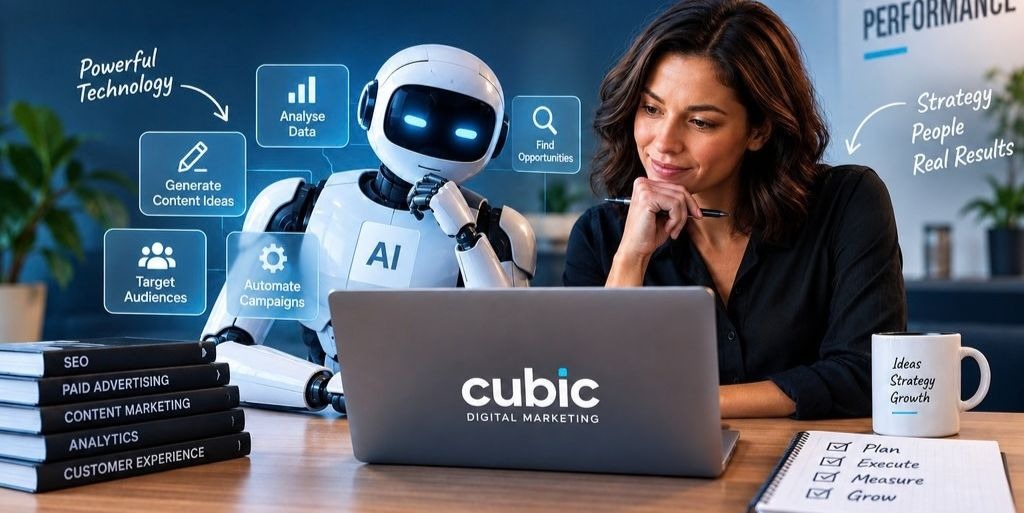
Artificial intelligence has quickly become part of everyday digital marketing. Marketers use AI to research keywords, analyse large amounts of data, generate content ideas, automate advertising, identify audiences, personalise messages and find patterns that might otherwise take hours to uncover.
Google Ads uses machine learning to optimise bids. SEO teams use AI to speed up research and analysis. Businesses use AI tools to create content, emails, social posts and campaign ideas. Analytics platforms increasingly use AI to highlight trends and unusual changes in performance. The possibilities are impressive.
But there is an important distinction businesses need to understand:
Using more AI does not automatically lead to better marketing results.
AI can make marketing faster. It can process more information. It can identify opportunities and automate repetitive work.
But it cannot fix a weak strategy, poor tracking, an unclear offer, bad customer experience or a website that does not convert.
The real opportunity is not to replace digital marketing with AI.
It is to combine AI’s speed and analytical capabilities with human experience, strategy and decision-making.
AI Has Changed How Digital Marketing Works
Digital marketing has always relied heavily on data.
Marketers analyse:
- Search behaviour
- Keywords
- Website traffic
- Advertising performance
- Conversion rates
- Customer journeys
- Competitor activity
- Audience behaviour
- Content performance
- Revenue and lead data
The challenge was often the amount of time required to collect and interpret all this information.
AI changes that.
A marketer can now analyse thousands of keywords much faster than before. Advertising platforms can adjust bids automatically based on signals that would be impossible for a person to evaluate individually. AI tools can summarise large datasets and help identify patterns.
This means marketers can spend less time processing information manually. But having more information is not the same as knowing what to do with it. That is where strategy becomes important.
The Real Digital Marketing Challenge is Not Access to AI
- Most businesses can access similar AI technology.
- Your competitors can use ChatGPT.
- They can use Google’s advertising automation.
- They can access SEO platforms with AI features.
- They can automate emails.
- They can create content faster.
- They can analyse competitors.
- So simply having AI is unlikely to become a long-term competitive advantage.
How you use it can be.
Consider two businesses using the same AI-powered advertising technology.
Business A has accurate conversion tracking, clearly defined goals, strong landing pages and reliable customer data.
Business B tracks every enquiry as an equal conversion, has a slow landing page and does not distinguish between a qualified lead and a poor-quality enquiry.
Both may be using the same advertising automation. But the AI is learning from completely different information. The technology may be identical. The inputs are not. And that can produce very different outcomes.
AI is Only as Useful as the Goal You Give it
Before asking what AI can automate, businesses should first ask:
- What are we actually trying to achieve?
- More traffic?
- More leads?
- More qualified leads?
- More sales?
- Higher revenue?
- Better return on advertising spend?
- Greater customer retention?
These are not interchangeable goals.
Imagine an SEO campaign that increases organic traffic by 80%.
It sounds successful.
But what if most of that additional traffic comes from informational searches that never generate enquiries?
Traffic increased.
Business growth did not.
The same problem can happen with paid advertising.
An automated campaign might increase the number of recorded conversions. But if the tracking system counts low-value actions or poor-quality leads as important conversions, the algorithm may optimise towards the wrong behaviour.
AI needs a meaningful objective.
Otherwise, it can become extremely efficient at achieving something that does not actually matter to the business.
Where AI Can Make Digital Marketing Better
Used correctly, AI can be extremely valuable. The goal should not be to avoid AI. The goal should be to understand where it provides the most value.
1. Faster Research and Data Analysis
One of AI’s biggest strengths is its ability to process large amounts of information quickly. A digital marketing team may need to review hundreds or thousands of:
- Keywords
- Search terms
- URLs
- Competitor pages
- Ad variations
- Analytics events
- Customer questions
- Content topics
AI can help organise this information, identify patterns and highlight areas that deserve closer investigation.
This can reduce hours of repetitive work.
But the final question still requires human judgment:
Which of these findings actually matters to this business?
2. Smarter Paid Advertising
AI is already deeply integrated into modern advertising platforms. Automated bidding can evaluate signals and adjust bids based on the likelihood of a conversion. AI-powered campaign types can also help advertisers reach users across different placements and stages of their journey.
That creates powerful opportunities.
But advertising automation still depends heavily on what advertisers provide.
That includes:
- Conversion tracking
- Campaign goals
- Budget
- Audience signals
- Creative assets
- Landing pages
- Customer data
- Conversion values
If those inputs are poor, automation does not magically repair them.
This leads to an important principle:
Do not simply automate your advertising. Improve what the automation is learning from.
3. Better SEO Research
AI can make many parts of SEO more efficient, but businesses still need a well-planned SEO strategy.
It can help marketers:
- Group related keywords
- Identify search intent
- Analyse content gaps
- Generate topic ideas
- Find related questions
- Review page structures
- Summarise competitor themes
- Identify internal linking opportunities
But SEO becomes risky when businesses confuse faster content production with better SEO.
Publishing 100 AI-generated articles is easy.
Publishing 100 genuinely useful articles that demonstrate experience, answer real customer questions and add something new to the web is much harder.
That difference matters.
The question should not be:
How much content can AI help us publish?
A better question is:
What can we publish that genuinely deserves to be found?
AI Content Is Not Automatically Good SEO Content
This is one of the biggest misconceptions surrounding AI and digital marketing.AI can produce grammatically correct content very quickly.
But grammatically correct content is not necessarily:
- Original
- Useful
- Accurate
- Experienced
- Persuasive
- Relevant to the business
- Better than existing search results
Ask an AI system to explain a common marketing topic and it can produce a reasonable answer within seconds. The problem is that thousands of other businesses can do exactly the same thing.
That creates what we can call commodity content.
It answers the question, but adds little that is new.
A stronger article might include:
- First-hand experience
- Original observations
- Real examples
- Internal data
- Expert commentary
- Lessons from actual campaigns
- A different way of solving the problem
- Details specific to the target customer
AI can help organise and develop these ideas.
It should not be the source of your experience.
Search is changing too
The discussion about AI in digital marketing is not limited to marketers using AI. Consumers are using it as well. People increasingly discover information through traditional Google results, AI-generated search experiences and conversational AI tools. That changes an important question for businesses.
Historically, SEO often focused on:
How do we rank this page?
That question still matters.
But businesses increasingly need to think about:
How do we become a useful and trustworthy source wherever people are looking for answers?
This makes strong SEO fundamentals even more important. A technically accessible website, clear information architecture, useful content, genuine expertise and trustworthy business information help search engines understand what a business offers.
There may be new terminology around AI search, AEO and GEO, but the foundation remains familiar:
Create information worth finding, understanding, citing and trusting.
AI Can Find an Opportunity. Humans Still Need to Decide What to Do
Imagine your analytics shows that a service page receives plenty of traffic but generates very few enquiries.
AI might help identify several possible problems:
- Visitors leave quickly
- Important information appears too far down the page
- The CTA is weak
- Mobile engagement is poor
- The page does not answer common questions
- Traffic may not match the right search intent
That analysis is useful.
But someone still has to decide what happens next.
- Should the page be rewritten?
- Should the offer change?
- Should the CTA be moved?
- Should certain keywords be deprioritised?
- Is the problem actually traffic quality rather than page design?
AI helps uncover possibilities.
Marketing experience helps determine which action makes sense.
More Automation can sometimes Hide Problems
Automation creates another risk. When platforms become easier to operate, marketers may spend less time investigating what is happening underneath.
A campaign might report:
50 conversions this month.
That number looks encouraging.
But an experienced marketer should ask:
- What counted as a conversion?
- Were they phone calls or form submissions?
- Were they genuine prospects?
- Did some come from branded searches?
- Were leads generated from the right locations?
- How many became customers?
- What did those customers generate in revenue?
Without these questions, automation can create the appearance of good performance while hiding weak business outcomes.
Dashboards tell us what happened. Marketing analysis needs to determine why it happened and what should happen next.
AI Cannot Fix a Weak Customer Journey
Imagine AI helps you find the perfect audience. Your advertising reaches exactly the right person at exactly the right time.
They click.
Then they arrive on a website that:
- Loads slowly
- Looks outdated
- Has confusing navigation
- Does not explain the service clearly
- Provides little evidence of trust
- Makes contacting the business difficult
AI succeeded.
The marketing journey still failed.
Digital marketing performance is rarely determined by one tool.
It is usually the result of several connected elements:
Audience → Message → Click → Landing Page → Trust → Conversion → Follow-Up → Sale
AI can improve parts of that journey.
It cannot compensate for every broken part.
Human Experience Becomes More Valuable, Not Less
There is an interesting side effect of widespread AI adoption. When everyone can produce information quickly, experience becomes more valuable.
Consider the difference between these two statements:
Generic advice:
“Businesses should regularly optimise their Google Ads campaigns.”
Experience-based insight:
A campaign can report more conversions while generating fewer useful leads if low-value actions are included as primary conversions.The second statement contains a practical lesson.
That type of knowledge usually comes from actually managing campaigns, investigating performance and seeing what happens when tracking or optimisation goes wrong.
AI can help communicate that experience.
It cannot retroactively create the experience itself.
For agencies, consultants and internal marketing teams, this makes practical expertise increasingly important.
A Better Model: Human Strategy + AI Capability
The most useful discussion is not:
AI vs humans.
A better model is:
Human strategy + AI capability.
AI is particularly strong at:
- Processing data
- Finding patterns
- Automating repetitive tasks
- Generating variations
- Summarising information
- Speeding up research
- Identifying anomalies
Humans remain essential for:
- Understanding business goals
- Evaluating lead quality
- Understanding customers
- Challenging misleading data
- Developing positioning
- Applying experience
- Making strategic trade-offs
- Checking accuracy
- Maintaining brand voice
- Deciding what matters
Put these together and you have a much stronger marketing process.
The AI Digital Marketing Loop
Instead of asking AI to “do the marketing”, businesses can use a simple five-stage process.
Step 1: Define the Business Outcome
Start with what actually matters.
For example:
Increase qualified enquiries for a high-value service.
That is more useful than simply targeting “more website traffic.”
Step 2: Give AI Quality Information
Provide reliable inputs.
This could include:
- Analytics data
- Search Console data
- CRM information
- Conversion tracking
- Customer questions
- Search term reports
- Existing content
- Competitor research
Better input creates a better foundation for analysis.
Step 3: Use AI to Find Opportunities
AI can help identify patterns, gaps and unusual behaviour. But treat its findings as inputs to a decision, not automatic instructions.
Step 4: Apply Human Judgment
Ask:
- Does this make sense?
- Does the data support it?
- Does it match what customers actually want?
- What are the risks?
- What should we prioritise?
- How will we measure success?
This is where marketing experience becomes critical.
Step 5: Test, Measure and Improve
Implement the change and measure the result. Then feed what you learned back into the next decision.
The process becomes:
Goal → Data → AI Analysis → Human Decision → Execution → Measurement → Learning
That is far more powerful than simply asking AI to generate more marketing activity.
Questions Businesses Should Ask Before Using More AI
Before adding another AI tool or automating another marketing process, ask:
- What problem are we trying to solve?
- What business outcome should improve?
- Is the data feeding the system accurate?
- How will we measure whether this actually worked?
- What decisions should remain human-led?
- Who will check the accuracy of AI-generated outputs?
- Are we improving customer experience or simply producing more activity?
- What happens when the AI recommendation is wrong?
These questions help shift the conversation from AI adoption to AI effectiveness.
And that is where businesses are more likely to find meaningful value.
The Future of Digital Marketing is Not Fully Automated
AI will continue improving.
Advertising platforms will automate more decisions.
Analytics tools will provide stronger predictions.
Search will become more conversational.
Content tools will become faster.
Personalisation will become easier.
Many tasks marketers manually perform today may eventually require little direct input.
But marketing itself is unlikely to become simply “press a button and generate growth.”
Businesses still compete for the same thing they always have:
Human attention, trust and action.
Understanding why someone chooses one company instead of another remains a marketing problem. Deciding which market to pursue remains a strategy problem. Creating an offer people genuinely want remains a business problem.
AI can help with all of them.
It does not eliminate them.
Use AI to Improve Marketing, Not Replace Marketing Thinking
The biggest advantage of AI is not that it allows businesses to remove people from marketing. It is that it allows experienced marketers to spend less time on repetitive work and more time making better decisions.
At Cubic Digital Marketing, we believe AI works best when it supports a clear digital strategy rather than replacing one.
We use technology to help analyse opportunities, improve efficiency and make better-informed marketing decisions. But every tool still needs to connect back to the same questions:
- Are we reaching the right audience?
- Are we giving them the information they need?
- Are we generating meaningful leads and sales?
- And can we prove that the marketing is helping the business grow?
Because AI can generate an answer in seconds. Turning that answer into measurable business growth is where digital marketing strategy still matters.
Ready to Build a Smarter Digital Marketing Strategy?
AI may be changing the tools, but successful digital marketing still starts with the right strategy.
If you want to explore how SEO, paid advertising, content and AI-powered search can work together to generate meaningful business growth, talk to the Cubic Digital Marketing team.
We can help you identify where AI can improve efficiency, where human expertise still matters and how to build a digital strategy focused on measurable results.
Frequently Asked Questions
Q:How is AI used in digital marketing?
A: AI can be used for data analysis, keyword research, advertising automation, audience targeting, content research, personalisation, forecasting and identifying patterns in customer behaviour. Its effectiveness depends on the quality of the data, goals and strategy behind it.
Q:Will AI replace digital marketers?
A: AI is more likely to change what digital marketers do than remove the need for marketing expertise. Repetitive research, analysis and production tasks can increasingly be automated, while strategy, customer understanding, quality control and business decision-making continue to require human involvement.
Q:Can AI improve SEO?
A: Yes. AI can assist with keyword research, topic analysis, content planning, competitor research, internal linking and data analysis. However, SEO performance still depends on technical accessibility, useful content, relevance, authority, user experience and other established SEO fundamentals
Q:Does Google penalise AI-generated content?
A: Google focuses on the purpose and quality of content rather than simply whether AI was involved in producing it. Using automation primarily to manipulate search rankings can violate Google’s spam policies. Businesses should focus on original, useful and people-first content rather than mass-producing pages simply because AI makes it possible.
Q:How can businesses use AI in Google Ads?
A: AI is already used in areas such as automated bidding and AI-powered campaign types. Businesses can benefit from these systems by providing accurate conversion tracking, appropriate campaign goals, useful creative assets and quality first-party data where available.
Q:What is the biggest risk of using AI in digital marketing?
A: One major risk is trusting output without validating it. AI can provide inaccurate information, misinterpret data or recommend actions that do not fit the business. Human review, accurate measurement and clear business goals should remain part of the process.
Q:What is the best way to combine AI with digital marketing?
A: Start with the business goal, provide reliable data, use AI to speed up analysis and execution, apply human judgment to important decisions, and measure the real business outcome. AI should strengthen the marketing process rather than become the strategy itself.