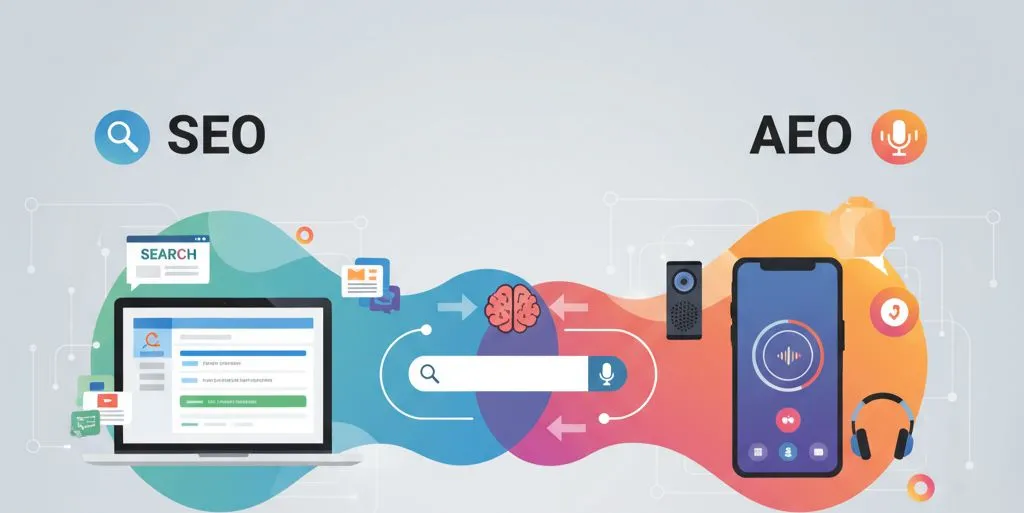
In today’s digital world, visibility is everything. Brands compete fiercely for attention across search engines, voice assistants, and AI-driven platforms. While Search Engine Optimization (SEO) has long been the cornerstone of online visibility, a new contender Answer Engine Optimization (AEO) is reshaping the way businesses approach content strategy.
If you have ever asked Alexa, Siri, or Google Assistant a question, you have already witnessed AEO in action. The future of search is conversational and intent-driven and understanding how SEO and AEO work together is crucial for staying relevant.
Let’s dive deep into what sets them apart, why both matter, and how you can combine their strengths for maximum impact.
What is SEO?
Search Engine Optimization (SEO) is the process of improving a website’s visibility in search engine results pages (SERPs). The goal is simple: attract organic (unpaid) traffic by ranking higher for relevant keywords. To achieve meaningful results, businesses need a smart SEO strategy that targets the right audience and aligns with their overall marketing goals.
Core Components of SEO
- On-Page SEO: Optimizing individual pages through meta tags, headings, internal links, and keyword-rich content.
- Off-Page SEO: Building domain authority through backlinks, brand mentions, and social signals.
- Technical SEO: Ensuring fast site speed, mobile optimization, and clean website architecture.
- Content SEO: Crafting high-quality, relevant content that satisfies user intent and keeps visitors engaged.
When done right, SEO helps your brand rank higher, drive more traffic, and convert visitors into customers.
What is AEO?
Answer Engine Optimization (AEO) is the evolution of SEO, focusing on optimizing content so that AI-powered assistants (like Google Assistant, Siri, or ChatGPT based systems) can easily extract, understand, and deliver your content as the best answer to a user’s query.
Unlike traditional SEO, which targets search results pages, AEO targets “answer engines.” These are systems that provide direct, conversational answers without requiring the user to click through to a website.
How AEO Works
When a user asks, “What’s the best time to post on Instagram?”, an answer engine scans the web, finds the most authoritative and structured content, and delivers the answer, often from featured snippets, FAQ sections, or structured data on websites.
AEO focuses on:
- Understanding search intent deeply.
- Structuring content for clarity and accuracy.
- Leveraging schema markup for context.
- Providing concise, direct answers.
In short, AEO helps your content become the answer, not just an option.
SEO vs. AEO: The Key Differences
While SEO and AEO share the same end goal – visibility, they operate differently in how they serve information and measure success.
| Aspect | SEO | AEO |
|---|---|---|
| Goal | Rank higher on search results pages (SERPs) | Provide direct, authoritative answers to queries |
| Platform Focus | Google, Bing, Yahoo | Voice assistants, chatbots, AI-powered tools |
| Content Format | Long-form, keyword-rich content | Concise, structured, and conversational content |
| Measurement Metrics | Click-through rate (CTR), impressions, traffic | Featured snippets, voice search visibility, zero-click results |
| Optimization Focus | Keywords and backlinks | Context, intent, and structured data |
| User Interaction | Users click to visit websites | Users get immediate answers (no clicks needed) |
Why AEO is the Future of Search
Voice and AI-driven search are no longer niche, they are mainstream. According to recent reports:
- Over 50% of online searches are now conversational or voice-based.
- Nearly 70% of smart speaker owners use their devices daily to find information.
This shift means traditional SEO alone is no longer enough.
Search behavior is evolving from “typing keywords” to asking questions conversationally. For example:
- Old SEO query: “best running shoes 2025”
- AEO query: “What are the best running shoes for beginners in 2025?”
To succeed in this new era, brands must understand contextual relevance and user intent, not just keyword density.
How to Combine SEO and AEO for Maximum Impact?
The most powerful strategy is not choosing between SEO and AEO, it is combining both. When SEO builds your foundation and AEO enhances your discoverability, you create a holistic visibility ecosystem.
A trusted digital marketing agency helps you balance both. Ensuring your content ranks on Google and becomes the preferred answer across AI-driven platforms.
Here’s how to merge the two effectively:
1. Focus on User Intent, Not Just Keywords
Modern algorithms and AI assistants prioritize intent over keywords. Instead of targeting isolated phrases, focus on understanding why users search.
Tips:
- Use tools like Google’s “People Also Ask” and Answer the Public to uncover common questions.
- Organize your content around topics, not just individual keywords.
- Incorporate conversational phrases that mimic how people actually ask questions.
2. Optimize for Featured Snippets
Featured snippets are those concise answer boxes at the top of Google.
To increase your chances of appearing:
- Answer questions directly in one to two sentences.
- Use H2 and H3 headings for clarity.
- Include bullet points or numbered lists to enhance readability.
- Add an FAQ section to target long-tail, voice-driven queries.
3. Implement Structured Data (Schema Markup)
Structured data, or schema markup, helps search engines and AI assistants understand the context of your content. By providing this extra layer of information, your pages are more likely to appear as rich results and be voice-search friendly.
Use schema markup for:
- FAQs: Highlight common questions and answers on your site.
- How to Guides: Show step-by-step instructions in search results.
- Product Reviews: Display ratings, reviews, and product details prominently.
- Local Business Details: Include address, phone number, business hours, and more for local SEO.
Implementing structured data not only boosts SEO performance but also improves visibility in voice search results and other AI-driven search features.
4. Craft Conversational, Natural Language Content
AI and voice search love natural, human-like language. Instead of forcing keywords into stiff sentences, focus on writing in a clear, conversational tone that is easy for people and AI to understand.
Example:
- Keyword stuffed: “Best running shoes cheap buy online 2025.”
- Conversational: “Looking for affordable running shoes in 2025? Here are some top-rated options for beginners.”
This approach not only improves SEO readability but also helps AI assistants interpret your content marketing strategy accurately, increasing your chances of appearing in voice search results and featured snippets.
5. Optimize for Mobile and Voice Search
With mobile and voice search on the rise, making your website accessible and easy to navigate is more important than ever. AI assistants and users expect fast, clear, and mobile-friendly content.
- Responsive Design: Ensure your site looks and works well on all devices phones, tablets, and desktops.
- Improve Page Speed: Aim for load times under 3 seconds to keep visitors and search engines happy.
- Optimize Meta Descriptions: Summarize answers clearly and concisely to improve click-throughs from search results.
- Voice-Friendly Content: Use short sentences, simple structure, and active voice so your content is easy to read aloud and understand.
By optimizing voice search and mobile performance, your website becomes faster, more user-friendly, and more likely to appear in featured snippets and voice search results.
6. Build Topical Authority
Both SEO and AEO favor websites that demonstrate expertise and trustworthiness. One way Google measures this is through its E-E-A-T framework — Experience, Expertise, Authoritativeness, and Trustworthiness.
Action steps:
- Create Pillar Content: Develop comprehensive, in-depth articles around your main niche topics. These act as cornerstone pieces for your website.
- Use Internal Linking: Connect your pillar content to related supporting articles. This gives readers and search engines deeper context.
- Earn Quality Backlinks: Get links from reputable websites in your industry to strengthen your domain authority and credibility.
By consistently building topical authority, your site becomes a go-to resource in your niche, which can improve rankings and trust with both users and search engines.
Real-World Example: SEO + AEO in Action
Let’s say you run a wellness blog..
Your SEO strategy targets keywords like “best yoga poses for beginners”, helping attract organic search traffic
Now, to incorporate AEO:
- Create a FAQ section answering questions like “What’s the easiest yoga pose for flexibility?”
- Add schema markup to highlight the FAQ and How-To sections.
- Write in short, conversational sentences that AI assistants can easily quote.
The result?
Your article not only ranks higher on Google but also becomes the spoken answer when someone asks their smart speaker combining SEO and AEO for maximum reach.
Common Mistakes to Avoid
Even seasoned marketers fall into these traps:
- Keyword stuffing: Hurts readability and context.
- Ignoring structured data: Makes it harder for AI to interpret content.
- Skipping question-based formats: Reduces chances of voice visibility.
- Focusing solely on rankings: Remember, zero-click results still drive brand recognition.
Conclusion: The Future Belongs to SEO + AEO Synergy
The digital landscape is evolving faster than ever. As search engines and AI-driven platforms become smarter, success depends on how well your brand adapts. SEO ensures your business gets discovered. AEO ensures your message is understood and delivered as the best possible answer. When these two strategies work hand in hand, they create a seamless path from curiosity to conversion.
At Cubic Digital, we help brands stay ahead of the curve by blending proven SEO strategies with innovative AEO techniques. Our team focuses on building digital experiences that not only rank well but also resonate with real people — across every search platform, device, and voice assistant.
Partner with us to transform your digital presence and achieve measurable, long-term growth in a rapidly evolving search ecosystem.