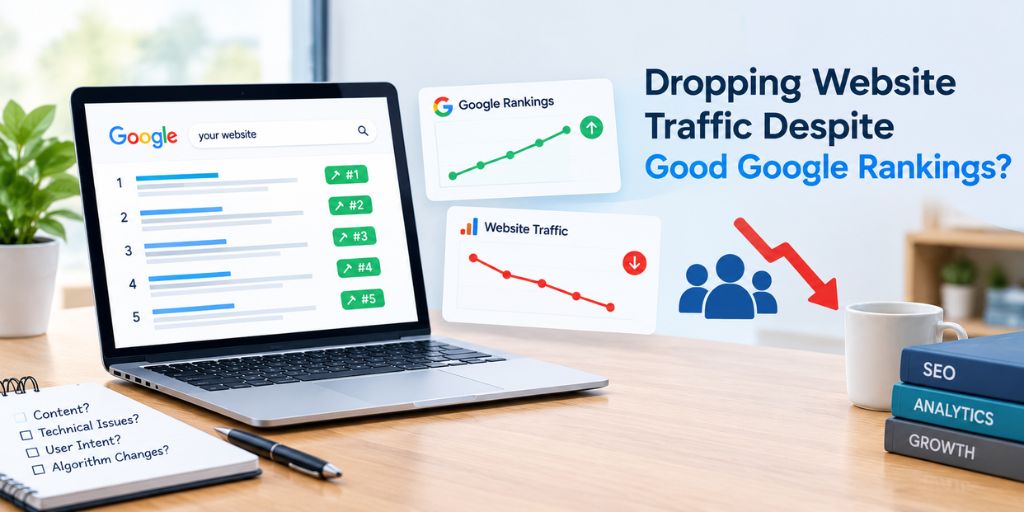
For years, SEO reports were simple. A page ranked well, organic traffic grew, and clicks increased.
In 2026, search is wider. People still use Google, but they also ask detailed questions in AI search tools. These tools can bring together information from many websites and show sources inside the answer. A customer may see your business and make a decision before visiting your site.
Rankings still matter. Google says core SEO practices remain important for its AI search experiences. The bigger change is that businesses need to measure more than rankings and traffic.
The goal is to be found, understood, trusted, visited, and chosen.
For a business like Cubic Digital, this change creates a clear opportunity. Strong SEO can now support visibility across both traditional search and newer AI driven search experiences.
Why SEO measurement is changing in 2026
Traditional SEO reporting focuses on keyword rankings, organic clicks, impressions, click through rate, backlinks, and conversions. These numbers still show how a website performs in traditional search.
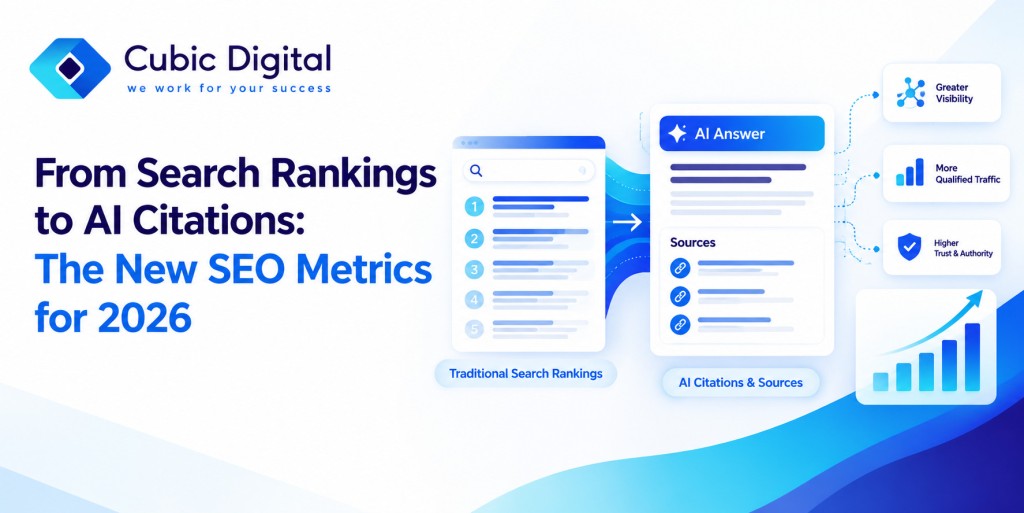
AI search adds another layer. A user can ask a long question, receive a direct answer, see several sources, and make a decision before visiting any of them.
Google explains that AI Overviews and AI Mode use relevant web content and continue to rely on core Search systems. Strong technical SEO, useful content, clear site structure, and good page experience still form the base. You can read the official Google guide to generative AI search for more detail.
The new SEO metrics businesses should track
1. AI citation visibility
An AI citation happens when an AI search system refers to your website or links to it as a source. For example, someone may ask which SEO agency can help a growing company. An AI tool may review several sources and mention a few businesses.
Track:
- Number of AI citations
- Pages cited most often
- Questions that trigger citations
- AI platforms where your site appears
- Changes in citation visibility over time
Regular testing is useful because there is no single public AI visibility score.
2. Brand mentions in AI answers
Your company may be named in an AI answer even when the exact page is not linked. This can build awareness during the research stage.
Ask important customer questions in the AI search tools your audience uses. Record whether your brand appears, how it is described, and which competitors appear beside it.
A simple report can include:
| Metric | What to check | Why it matters |
|---|---|---|
| AI citations | Source links to your site | Shows source visibility |
| Brand mentions | Brand appears in answers | Shows awareness |
| Ranking position | Google search position | Shows search strength |
| Organic clicks | Visits from search | Shows traffic |
| Qualified leads | Leads from search | Shows business value |
| Revenue | Sales linked to search | Shows real impact |
The goal is not to chase a new number just because it is new. Each metric should help you understand whether search visibility is helping the business.
3. Visibility across the full search journey
A customer may not search your main keyword first. They may begin with a problem, ask for advice, compare solutions, check reviews, and then search for a specific company.
Build content for different stages:
- Problem questions
- Educational questions
- Comparison questions
- Service questions
- Pricing questions
- Local questions
- Brand questions
This helps your website become useful before the customer is ready to buy.
For a deeper look at answer focused search, see SEO vs AEO and how to combine them.
4. Search visibility share
Search visibility can include Google results, AI answers, local results, review sites, and trusted third party sources.
Create a list of important customer questions and check them each month. Record where your business appears and which competitors appear more often. This gives your team a wider view than one ranking report.
5. Qualified organic traffic
Traffic is still important, but traffic quality matters more than raw visits.
A site can receive thousands of visitors and produce few customers. Another site may receive fewer visitors but generate strong leads.
Track:
- Engaged visits
- Time spent on key pages
- Contact form submissions
- Calls
- Demo requests
- Sales
- Revenue from organic traffic
This connects SEO work with real business results.
For businesses that need a stronger search base, SEO services for long term search growth can support technical work, content planning, search visibility, and lead focused SEO.
6. Content citation rate
Not every page has the same chance of being useful to AI systems. Pages that answer real questions clearly and provide useful detail can be more valuable than pages that simply repeat common information.
Review your content and ask:
- Does the page answer a clear customer question?
- Does it include original examples or useful details?
- Does it show real experience?
- Does it use trusted sources where needed?
- Is it easy to read and scan?
This is where strong content marketing services can add value. Good content should help people first while making the subject clear to search systems.
7. Brand trust and authority signals
AI search makes brand reputation more important. Keep your business information clear across your website, business profiles, review platforms, industry listings, social profiles, and trusted partner sites.
Publish proof of real work too. Case studies, original research, expert comments, customer results, and useful examples give people more reasons to trust your content.
Google advises site owners to focus on helpful, reliable, people first content instead of creating content only for search systems.
8. Conversion rate from search
The final question is simple. Did search visibility help the business grow?
Track conversions from organic search and compare them with traffic and visibility changes. Rankings show discovery, AI citations show source visibility, traffic shows visits, leads show action, and revenue shows business value.
This moves SEO reporting from activity to results.
How to build a 2026 SEO measurement plan
You do not need a huge dashboard.
Step 1: Keep your core SEO metrics
Track rankings, impressions, clicks, click through rate, organic traffic, backlinks, and conversions.
Step 2: Add AI visibility checks
Test important customer questions across the AI search platforms that matter to your audience. Record mentions, citations, competitors, and source types.
Step 3: Connect visibility to behavior
Compare AI visibility with branded search, direct visits, organic traffic, leads, and conversions.
Step 4: Improve important pages
Answer questions directly, add useful examples, show experience, strengthen internal links, and remove weak information.
For more practical ideas, read why a website may not show in AI search.
What SEO teams should stop doing
The shift to AI search does not mean using tricks.
Avoid:
- Writing many weak pages just to cover every question
- Repeating the same keyword too often
- Publishing content with little original value
- Buying unrelated links
- Treating AI citations as a guaranteed ranking factor
- Measuring success only by traffic
- Ignoring technical SEO because AI search is growing
Google says there are no special technical requirements or special markup needed just to appear in AI Overviews or AI Mode. Strong SEO foundations and useful content remain important.
OpenAI also explains how websites can manage OAI SearchBot access for ChatGPT search. You can review the OpenAI publisher guidance if ChatGPT visibility is part of your plan.
The role of a wider digital marketing strategy
SEO is becoming part of a wider visibility plan.
Your website needs useful content. Your service pages need clear information. Your business profiles need accurate details. Your brand needs proof and authority.
A wider digital marketing strategy can connect these activities instead of treating each one as a separate task.
Conclusion: Measure visibility, not just rankings
Search rankings are not disappearing in 2026. They are becoming one part of a larger picture.
The strongest SEO reports will combine traditional numbers with new visibility signals. Track rankings and clicks, but also watch AI citations, brand mentions, search visibility, qualified traffic, leads, conversions, and revenue.
Most importantly, focus on useful content and real value. AI search can change how people discover information, but people still want clear answers, trusted businesses, and good experiences.
The future of SEO is not about choosing between Google and AI search. It is about building a strong digital presence that can be found and trusted wherever customers search.
If your business is ready to measure search visibility in a smarter way, now is the time to review your SEO strategy. Talk to the team at Cubic Digital about building a search and digital marketing plan focused on visibility, qualified traffic, leads, and growth.