The useful part of this update isn’t in the announcement. It’s in what Google didn’t say.
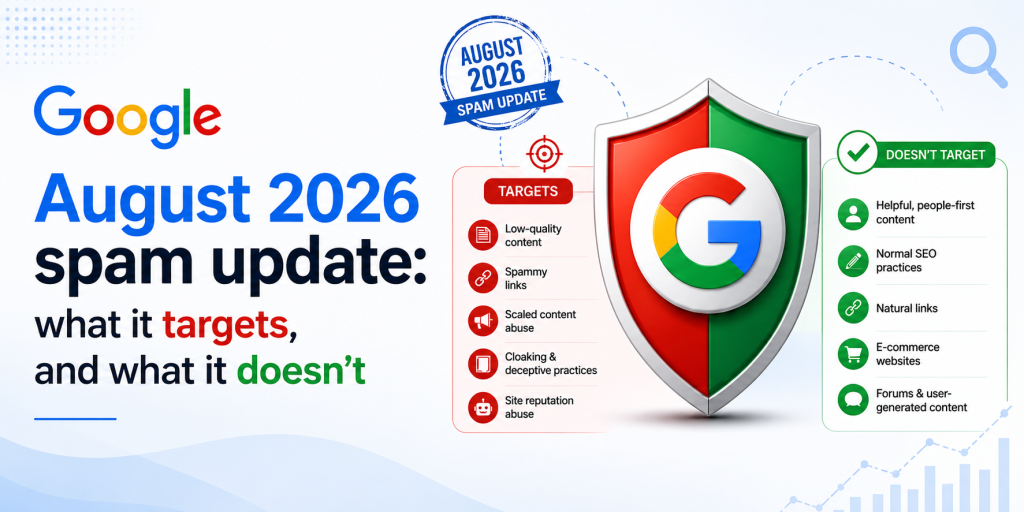
Google logged the August 2026 spam update on its Search Status Dashboard just after 9:27 a.m. Pacific on August 18. It’s a normal spam update, it runs across every language and region, and Google expects it to finish in a few days. Standard stuff, and you’ll read that same paragraph on a dozen sites this week.
Now the part those sites tend to skip. This update shipped without any new spam policy attached. Google also didn’t call it a link spam update, and when an update actually deals with links, Google has a long habit of putting the word “link” right in the name. Early reporting lines up with that: the read going around is that link spam and the site reputation abuse policy aren’t what this one is chasing.
Hold onto that. It changes what you should do next, and more to the point, what you shouldn’t.
Why the exclusions matter more than the rollout
Here’s the reflex. Rankings wobble, panic sets in, and someone opens their backlink tool and starts building a disavow file.
If links are not in scope, that whole exercise is wasted motion. You would be scrubbing something Google didn’t touch while the real cause sits there, untouched.
And this is not a harmless mistake. Content problems can be walked back. Fix the pages, wait, and the systems can reassess you. Links don’t work that way. Once Google discounts a batch of spammy links, whatever ranking lift they gave you is simply gone, and no cleanup brings it back. So “just audit your links” isn’t the safe default it pretends to be. For this update, it’s a detour.
Read it as a content and behaviour update, because that’s where the evidence points.
How long you should actually wait
“A few days” is what the note says. You can be sharper than that, because the two spam updates before this one give you a yardstick.
March 2026 wrapped in roughly nineteen and a half hours, the quickest spam rollout Google has ever confirmed. June 2026 took about two days. Both carried the exact same “few days” wording this one does.
So set your expectation at one to three days from August 18, not a fortnight of refreshing your charts. Mark a checkpoint date. Pull your Search Console numbers from before and after the 18th, and ignore the noisy day-to-day swings while it’s still moving.
The thread worth keeping an eye on
There’s a bigger question sitting right next to this update. Back in May 2026, Google spelled out that its spam policies also cover attempts to game its AI answers, including AI Overviews and AI Mode. The June update was the first to land after that.
Nobody at Google has said August enforces it. But if your recent wins came from tricks built to muscle into AI Overviews rather than actually answer the query, that’s the first place to look, ahead of the usual checklist.
What to check, in order
Most sites won’t feel a thing from a spam update. If yours took a real, lasting hit that lines up with August 18, work through this in order instead of rewriting everything at once.
Start by confirming it’s the update and not random noise. Compare impressions, clicks, and average position across the 18th, and give the rollout room to finish before you read anything into it.
Then check Manual Actions in Search Console. A drop isn’t a penalty. No manual action means you’re looking at an algorithmic shift, and that gets diagnosed differently.
Next, look hard at pages you built for search engines rather than people. Thin auto-generated articles. Near-identical location pages with no real local detail. Programmatic pages stamped out at scale to catch queries. That’s the kind of thing a content spam update goes after.
And leave the links alone for now. Given what’s out of scope here, your backlink profile is not where this week’s hours should go.
The honest version
Anyone telling you exactly what this update punishes, while it’s still rolling out and Google has published nothing past a dashboard note, is guessing. What’s actually solid is smaller and more useful. It’s a content and behaviour update. It wasn’t named a link spam update and reportedly doesn’t go after links or site reputation abuse. And the last two rollouts of 2026 both finished inside a couple of days.
So diagnose first, change second. Read your data past August 18, work out whether you were even affected, and if you were, go where Google’s spam policies actually point, not straight to your links.
One more thing worth saying plainly: recovery from a spam update tends to be slow. Google’s systems have to relearn that your site plays by the rules, and that can stretch over months, not days. There’s no switch to flip.
If you’d rather not read the tea leaves alone, the team at Cubic Digital can go through your Search Console data with you, work out whether this update touched your site, and tell you what to do if it did.